I'm going to analyze two functions.
phase_2
read_six_numbers
__isoc99_sscanf@plt
Let's analyze them in reverse order.
__isoc99_sscanf@plt
In C, sscanf is a function that reads input from a string into other variables, and I'm guessing it's similar here.
read_six_numbers
Dump of assembler code for function read_six_numbers:
   0x0000555555401acc <+0>:	sub    $0x8,%rsp
   0x0000555555401ad0 <+4>:	mov    %rsi,%rdx
   0x0000555555401ad3 <+7>:	lea    0x4(%rsi),%rcx
   0x0000555555401ad7 <+11>:	lea    0x14(%rsi),%rax
   0x0000555555401adb <+15>:	push   %rax
   0x0000555555401adc <+16>:	lea    0x10(%rsi),%rax
   0x0000555555401ae0 <+20>:	push   %rax
   0x0000555555401ae1 <+21>:	lea    0xc(%rsi),%r9
   0x0000555555401ae5 <+25>:	lea    0x8(%rsi),%r8
   0x0000555555401ae9 <+29>:	lea    0x12f1(%rip),%rsi        # 0x555555402de1
   0x0000555555401af0 <+36>:	mov    $0x0,%eax
   0x0000555555401af5 <+41>:	callq  0x555555400fc0 <__isoc99_sscanf@plt>
   0x0000555555401afa <+46>:	add    $0x10,%rsp
   0x0000555555401afe <+50>:	cmp    $0x5,%eax
   0x0000555555401b01 <+53>:	jle    0x555555401b08 <read_six_numbers+60>
   0x0000555555401b03 <+55>:	add    $0x8,%rsp
   0x0000555555401b07 <+59>:	retq
   0x0000555555401b08 <+60>:	callq  0x555555401a90 <explode_bomb>
<+29>
%rsi is a register commonly used for arguments.
I looked at what value gets passed into this register.
(gdb) x/s 0x555555402de1
0x555555402de1:	"%d %d %d %d %d %d"
It was "%d %d %d %d %d %d". So we can think of sscanf as reading 6 integers from the string, separated by spaces.
<+50 ~ 53>
Looking just at the key point, if the value of %eax is less than or equal to 5 it jumps to the bomb, so we have to enter 6 or more numbers. So we can infer that the read_six_number function returns the number of values through %eax.
<main>
   0x00005555554011f6 <+108>:	callq  0x555555400f00 <puts@plt>
   0x00005555554011fb <+113>:	callq  0x555555401b0d <read_line>
   0x0000555555401200 <+118>:	mov    %rax,%rdi
   0x0000555555401203 <+121>:	callq  0x555555401304 <phase_2>
   0x0000555555401208 <+126>:	callq  0x555555401c51 <phase_defused>
<+113> : Calls the read_line function. We can infer it's a function that reads one line of input.
<+118> : Since it passes a value to %rdi, we can infer the input string is stored in %rdi.
I ran a test, and the guess was right.

<__isoc_sscanf> <read_six_numbers>
Through the analysis so far,
the conclusions I got from testing are these.
- The string passed via %rsi lets __isoc99_sscanf decide what format to read the input in. In this case "%d %d %d %d %d %d" was passed, so we can tell it reads 6 integers.
- As __isoc99_sscanf runs, the input string is passed from %rdi and, through the sscanf function, stored at %rsp as an integer array.
- In read_six_numbers, if the integer array has 5 or fewer elements, the bomb explodes.
- read_six_numbers returns the number of integers entered as its return value. More precisely, read_six_numbers doesn't store anything in %rax, so it's the __isoc99_sscanf function that returns the number of integers entered in %rax.
phase_2
Dump of assembler code for function phase_2:
=> 0x0000555555401304 <+0>:	push   %rbp
   0x0000555555401305 <+1>:	push   %rbx
   0x0000555555401306 <+2>:	sub    $0x28,%rsp
   0x000055555540130a <+6>:	mov    %fs:0x28,%rax
   0x0000555555401313 <+15>:	mov    %rax,0x18(%rsp)
   0x0000555555401318 <+20>:	xor    %eax,%eax
   0x000055555540131a <+22>:	mov    %rsp,%rsi
   0x000055555540131d <+25>:	callq  0x555555401acc <read_six_numbers>
   0x0000555555401322 <+30>:	cmpl   $0x1,(%rsp)
   0x0000555555401326 <+34>:	jne    0x555555401331 <phase_2+45>
   0x0000555555401328 <+36>:	mov    %rsp,%rbx
   0x000055555540132b <+39>:	lea    0x14(%rbx),%rbp
   0x000055555540132f <+43>:	jmp    0x555555401341 <phase_2+61>
   0x0000555555401331 <+45>:	callq  0x555555401a90 <explode_bomb>
   0x0000555555401336 <+50>:	jmp    0x555555401328 <phase_2+36>
   0x0000555555401338 <+52>:	add    $0x4,%rbx
   0x000055555540133c <+56>:	cmp    %rbp,%rbx
   0x000055555540133f <+59>:	je     0x555555401351 <phase_2+77>
   0x0000555555401341 <+61>:	mov    (%rbx),%eax
   0x0000555555401343 <+63>:	add    %eax,%eax
   0x0000555555401345 <+65>:	cmp    %eax,0x4(%rbx)
   0x0000555555401348 <+68>:	je     0x555555401338 <phase_2+52>
   0x000055555540134a <+70>:	callq  0x555555401a90 <explode_bomb>
   0x000055555540134f <+75>:	jmp    0x555555401338 <phase_2+52>
   0x0000555555401351 <+77>:	mov    0x18(%rsp),%rax
   0x0000555555401356 <+82>:	xor    %fs:0x28,%rax
   0x000055555540135f <+91>:	jne    0x555555401368 <phase_2+100>
   0x0000555555401361 <+93>:	add    $0x28,%rsp
   0x0000555555401365 <+97>:	pop    %rbx
   0x0000555555401366 <+98>:	pop    %rbp
   0x0000555555401367 <+99>:	retq
   0x0000555555401368 <+100>:	callq  0x555555400f20 <__stack_chk_fail@plt>
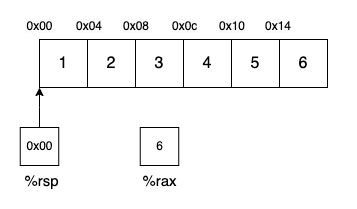
According to what we found analyzing read_six_number above,
the values we entered have the structure shown on the right.
(addresses are examples)
<+30 ~ 34>
(%rsp) is the first number we entered.
At <+30> it compares it with 1, and at <+34> if the first number isn't 1 it goes to <+45>.
   0x0000555555401322 <+30>:	cmpl   $0x1,(%rsp)
   0x0000555555401326 <+34>:	jne    0x555555401331 <phase_2+45>
If it goes to <+45> the bomb explodes, so the first number has to be 1.
0x0000555555401331 <+45>: callq 0x555555401a90 <explode_bomb>
<+30 ~ 34>
From here on, the code runs with the first number we entered guaranteed to be 1.
<+36>:	mov    %rsp,%rbx
<+39>:	lea    0x14(%rbx),%rbp
<+43>:  jmp    0x555555401341 <phase_2+61>
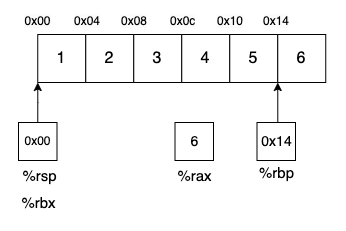
At <+36> it makes %rbx also hold a pointer to the first number.
At <+39> it stores the address plus 0x14 in %rbp,
so %rbp points to the 6th number we entered.
At <+43> it jumps to <+61>.
<+61 ~ 68>
<+61>:	mov    (%rbx),%eax
<+63>:	add    %eax,%eax
<+65>:	cmp    %eax,0x4(%rbx)
<+68>:	je     0x555555401338 <phase_2+52>
<+70>:	callq  0x555555401a90 <explode_bomb>
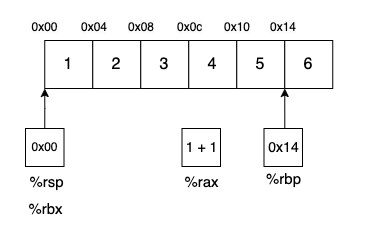
<+61> : Copies the first number into %rax.
<+63> : Multiplies the value in %rax by 2.
<+65> : 0x4(%rbx) means the number after the one %rbx points to. So it compares with the second number.
<+68> : If the second number equals the first number times 2, it goes back to <+52>. If not, the bomb explodes at <+70>.
<+52 ~ 61>
   0x0000555555401338 <+52>:	add    $0x4,%rbx
   0x000055555540133c <+56>:	cmp    %rbp,%rbx
   0x000055555540133f <+59>:	je     0x555555401351 <phase_2+77>
   0x0000555555401341 <+61>:	mov    (%rbx),%eax
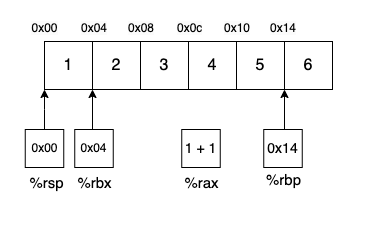
<+52> : Adds 0x04 to %rbx so it points to the next element.
<+56> : Compares the pointer to the last element with the pointer to the second element.
<+59> : If the address equals the last element's, it jumps to <+77>.
<+61> : Otherwise, from <+61> until %rbx equals %rbp, that is, %rax again has to hold %rbx times 2, and it repeats with %rbx pointing to the next element until it reaches the last element.
<+77 ~ 99>
   0x0000555555401351 <+77>:	mov    0x18(%rsp),%rax
   0x0000555555401356 <+82>:	xor    %fs:0x28,%rax
   0x000055555540135f <+91>:	jne    0x555555401368 <phase_2+100>
   0x0000555555401361 <+93>:	add    $0x28,%rsp
   0x0000555555401365 <+97>:	pop    %rbx
   0x0000555555401366 <+98>:	pop    %rbp
   0x0000555555401367 <+99>:	retq
If you've made it this far, the numbers you enter have to satisfy the following formula.
a[i+1] = a[i] * 2 : 0 <= i <= 5, a[i] = 1
It pops phase_2 off the stack.
So the answer is the following.
1 2 4 8 16 32