main
<+148> : Since the return value of read_line in the main function is stored in %rdi, we can infer that the input string is stored in %rdi.
   0x0000555555401214 <+138>:	callq  0x555555400f00 <puts@plt>
   0x0000555555401219 <+143>:	callq  0x555555401b0d <read_line>
   0x000055555540121e <+148>:	mov    %rax,%rdi
   0x0000555555401221 <+151>:	callq  0x55555540136d <phase_3>
Testing confirmed that it matches.
(gdb) x/s $rdi
0x555555604760 <input_strings+160>:	"50 100"
Analyzing __isoc99_sscanf
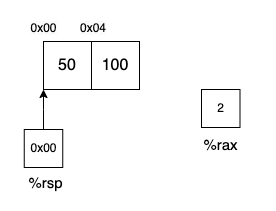
We already figured out a lot about the __isoc99_sscanf function in phase2.
- The integers we entered are converted into an array from the string stored in %rdi.
- A pointer to the first element is stored in %rsp.
- The number of integers entered is returned in %rax.
So when we enter 50 100, we get the situation on the right.
Phase_3
Dump of assembler code for function phase_3:
   0x000055555540136d <+0>:	sub    $0x18,%rsp
   0x0000555555401371 <+4>:	mov    %fs:0x28,%rax
   0x000055555540137a <+13>:	mov    %rax,0x8(%rsp)
   0x000055555540137f <+18>:	xor    %eax,%eax
   0x0000555555401381 <+20>:	lea    0x4(%rsp),%rcx
   0x0000555555401386 <+25>:	mov    %rsp,%rdx
   0x0000555555401389 <+28>:	lea    0x1a5d(%rip),%rsi        # 0x555555402ded
   0x0000555555401390 <+35>:	callq  0x555555400fc0 <__isoc99_sscanf@plt>
   0x0000555555401395 <+40>:	cmp    $0x1,%eax
   0x0000555555401398 <+43>:	jle    0x5555554013b3 <phase_3+70>
   0x000055555540139a <+45>:	cmpl   $0x7,(%rsp)
   0x000055555540139e <+49>:	ja     0x5555554013eb <phase_3+126>
   0x00005555554013a0 <+51>:	mov    (%rsp),%eax
   0x00005555554013a3 <+54>:	lea    0x1796(%rip),%rdx        # 0x555555402b40
   0x00005555554013aa <+61>:	movslq (%rdx,%rax,4),%rax
   0x00005555554013ae <+65>:	add    %rdx,%rax
   0x00005555554013b1 <+68>:	jmpq   *%rax
   0x00005555554013b3 <+70>:	callq  0x555555401a90 <explode_bomb>
   0x00005555554013b8 <+75>:	jmp    0x55555540139a <phase_3+45>
   0x00005555554013ba <+77>:	mov    $0x8c,%eax
   0x00005555554013bf <+82>:	jmp    0x5555554013fc <phase_3+143>
   0x00005555554013c1 <+84>:	mov    $0x3be,%eax
   0x00005555554013c6 <+89>:	jmp    0x5555554013fc <phase_3+143>
   0x00005555554013c8 <+91>:	mov    $0x79,%eax
   0x00005555554013cd <+96>:	jmp    0x5555554013fc <phase_3+143>
   0x00005555554013cf <+98>:	mov    $0x2c9,%eax
   0x00005555554013d4 <+103>:	jmp    0x5555554013fc <phase_3+143>
   0x00005555554013d6 <+105>:	mov    $0x379,%eax
   0x00005555554013db <+110>:	jmp    0x5555554013fc <phase_3+143>
   0x00005555554013dd <+112>:	mov    $0x347,%eax
   0x00005555554013e2 <+117>:	jmp    0x5555554013fc <phase_3+143>
   0x00005555554013e4 <+119>:	mov    $0x39a,%eax
   0x00005555554013e9 <+124>:	jmp    0x5555554013fc <phase_3+143>
   0x00005555554013eb <+126>:	callq  0x555555401a90 <explode_bomb>
   0x00005555554013f0 <+131>:	mov    $0x0,%eax
   0x00005555554013f5 <+136>:	jmp    0x5555554013fc <phase_3+143>
   0x00005555554013f7 <+138>:	mov    $0x123,%eax
   0x00005555554013fc <+143>:	cmp    %eax,0x4(%rsp)
   0x0000555555401400 <+147>:	je     0x555555401407 <phase_3+154>
   0x0000555555401402 <+149>:	callq  0x555555401a90 <explode_bomb>
   0x0000555555401407 <+154>:	mov    0x8(%rsp),%rax
   0x000055555540140c <+159>:	xor    %fs:0x28,%rax
   0x0000555555401415 <+168>:	jne    0x55555540141c <phase_3+175>
   0x0000555555401417 <+170>:	add    $0x18,%rsp
   0x000055555540141b <+174>:	retq
   0x000055555540141c <+175>:	callq  0x555555400f20 <__stack_chk_fail@plt>
<+40 ~ 49>
   0x0000555555401395 <+40>:	cmp    $0x1,%eax
   0x0000555555401398 <+43>:	jle    0x5555554013b3 <phase_3+70>
   0x000055555540139a <+45>:	cmpl   $0x7,(%rsp)
   0x000055555540139e <+49>:	ja     0x5555554013eb <phase_3+126>
0x00005555554013b3 <+70>: callq 0x555555401a90 <explode_bomb>
0x00005555554013eb <+126>: callq 0x555555401a90 <explode_bomb>
<+40> : Right now R[%eax] is the number of numbers entered. It compares the number of numbers entered with 1.
<+43> : If it's 1 or less, it jumps to <+70>. <+70> is the bomb, so you have to enter 2 or more numbers. (Since we assumed we entered 50, the bomb explodes.)
<+45> : (%rsp) is the first number we entered. It compares the first number with 7.
<+49> : If it's greater than 7 or less than 0 (since ja is an unsigned operation), it jumps to <+126>. That's the bomb, so the first number has to be between 0 and 7.
From here on, assume we entered 0 291.
<+51 ~ 68>
   0x00005555554013a0 <+51>:	mov    (%rsp),%eax
   0x00005555554013a3 <+54>:	lea    0x1796(%rip),%rdx        # 0x555555402b40
   0x00005555554013aa <+61>:	movslq (%rdx,%rax,4),%rax
   0x00005555554013ae <+65>:	add    %rdx,%rax
   0x00005555554013b1 <+68>:	jmpq   *%rax
<+51> : Stores the first number we entered in %eax.
<+54> : When the <+54> instruction runs, R[%rip] is the address of <+61>, 0x00005555554013aa. (%rip, the PC, points to the address of the next instruction to run.)
So R[%rdx] = 0x1796 + 0x00005555554013aa = 0x555555402b40.
<+61> : %rax means the first number we entered, and it takes that number, which is between 0 and 7, multiplies it by 4, adds it to %rdx, and stores the value at that address in %rax. I was able to find the referenced values of R[%rdx] + 4 * R[%rax] by testing in gdb.
| First number | R[%rdx] + 4 * R[%rax] | %rax = M[R[%rdx] + 4 * R[%rax]] Hex, Dec |
|---|---|---|
| 0 | 0x555555402b40 | 0xffffffffffffe8b7, -5961 |
| 1 | 0x555555402b44 | 0xffffffffffffe87a, -6022 |
| 2 | 0x555555402b48 | 0xffffffffffffe881, -6015 |
| 3 | 0x555555402b5c | 0xffffffffffffe888, -6008 |
| 4 | 0x555555402b60 | 0xffffffffffffe88f, -6001 |
| 5 | 0x555555402b64 | 0xffffffffffffe896, -5994 |
| 6 | 0x555555402b68 | 0xffffffffffffe89d, -5987 |
| 7 | 0x555555402b7c | 0xffffffffffffe8a4, -5980 |
<+65> : Adds %rdx to %rax once more. ( R[%rdx] is 0x555555402b40, 93824990849856(demical) )
<+68> : Jumps to the address held in %rax. Marking where it jumps for each %rax number and organizing it gives the following.
| First number | %rax Hex, Dec | jump <+ ? > |
|---|---|---|
| 0 | 0x5555554013F7, 93824990843895 | <+138> |
| 1 | 0x5555554013BA, 93824990843834 | <+77> |
| 2 | 0x5555554013C1, 93824990843841 | <+84> |
| 3 | 0x5555554013C8, 93824990843848 | <+119> |
| 4 | 0x5555554013CF, 93824990843855 | <+98> |
| 5 | 0x5555554013D6, 93824990843862 | <+105> |
| 6 | 0x5555554013DD, 93824990843869 | <+112> |
| 7 | 0x5555554013E4, 93824990843876 | <+119> |
<77 ~ 138>
   0x00005555554013ba <+77>: mov    $0x8c,%eax
   0x00005555554013bf <+82>: jmp    0x5555554013fc <phase_3+143>
   0x00005555554013c1 <+84>: mov    $0x3be,%eax
   0x00005555554013c6 <+89>: jmp    0x5555554013fc <phase_3+143>
   0x00005555554013c8 <+91>: mov    $0x79,%eax
   0x00005555554013cd <+96>: jmp    0x5555554013fc <phase_3+143>
   0x00005555554013cf <+98>: mov    $0x2c9,%eax
   0x00005555554013d4 <+103>: jmp    0x5555554013fc <phase_3+143>
   0x00005555554013d6 <+105>: mov    $0x379,%eax
   0x00005555554013db <+110>: jmp    0x5555554013fc <phase_3+143>
   0x00005555554013dd <+112>: mov    $0x347,%eax
   0x00005555554013e2 <+117>: jmp    0x5555554013fc <phase_3+143>
   0x00005555554013e4 <+119>: mov    $0x39a,%eax
   0x00005555554013e9 <+124>: jmp    0x5555554013fc <phase_3+143>
   0x00005555554013eb <+126>: callq  0x555555401a90 <explode_bomb>
   0x00005555554013f0 <+131>: mov    $0x0,%eax
   0x00005555554013f5 <+136>: jmp    0x5555554013fc <phase_3+143>
   0x00005555554013f7 <+138>: mov    $0x123,%eax
Depending on the first number, it jumps and stores a value in %eax.
Organized by number, it looks like this.
| First number | jump <+ ? > | Demical : R[%eax] |
|---|---|---|
| 0 | <+138> | 291 |
| 1 | <+77> | 140 |
| 2 | <+84> | 958 |
| 3 | <+119> | 922 |
| 4 | <+98> | 713 |
| 5 | <+105> | 889 |
| 6 | <+112> | 839 |
| 7 | <+119> | 922 |
<143 ~ 174>
   0x00005555554013fc <+143>:	cmp    %eax,0x4(%rsp)
   0x0000555555401400 <+147>:	je     0x555555401407 <phase_3+154>
   0x0000555555401402 <+149>:	callq  0x555555401a90 <explode_bomb>
   0x0000555555401407 <+154>:	mov    0x8(%rsp),%rax
   0x000055555540140c <+159>:	xor    %fs:0x28,%rax
   0x0000555555401415 <+168>:	jne    0x55555540141c <phase_3+175>
   0x0000555555401417 <+170>:	add    $0x18,%rsp
   0x000055555540141b <+174>:	retq
<+143> : 0x4(%rsp) means the second number we entered. It's comparing the second number with R[%eax].
<+147> : If R[%eax] from the table above equals the second number, it jumps to <+154>.
<+149> : If the second number is different from R[%eax], the bomb explodes, so it turns out the second number has to equal R[%eax].
So the answer is the following.
| First number | Second number |
|---|---|
| 0 | 291 |
| 1 | 140 |
| 2 | 958 |
| 3 | 922 |
| 4 | 713 |
| 5 | 889 |
| 6 | 839 |
| 7 | 922 |