phase_5
Dump of assembler code for function phase_5:
=> 0x00005555554014ca <+0>:	push   %rbx
   0x00005555554014cb <+1>:	mov    %rdi,%rbx
   0x00005555554014ce <+4>:	callq  0x55555540176f <string_length>
   0x00005555554014d3 <+9>:	cmp    $0x6,%eax
   0x00005555554014d6 <+12>:	jne    0x555555401509 <phase_5+63>
   0x00005555554014d8 <+14>:	mov    %rbx,%rax
   0x00005555554014db <+17>:	lea    0x6(%rbx),%rdi
   0x00005555554014df <+21>:	mov    $0x0,%ecx
   0x00005555554014e4 <+26>:	lea    0x1675(%rip),%rsi        # 0x555555402b60 <array.3417>
   0x00005555554014eb <+33>:	movzbl (%rax),%edx
   0x00005555554014ee <+36>:	and    $0xf,%edx
   0x00005555554014f1 <+39>:	add    (%rsi,%rdx,4),%ecx
   0x00005555554014f4 <+42>:	add    $0x1,%rax
   0x00005555554014f8 <+46>:	cmp    %rdi,%rax
   0x00005555554014fb <+49>:	jne    0x5555554014eb <phase_5+33>
   0x00005555554014fd <+51>:	cmp    $0x3a,%ecx
   0x0000555555401500 <+54>:	je     0x555555401507 <phase_5+61>
   0x0000555555401502 <+56>:	callq  0x555555401a90 <explode_bomb>
   0x0000555555401507 <+61>:	pop    %rbx
   0x0000555555401508 <+62>:	retq
   0x0000555555401509 <+63>:	callq  0x555555401a90 <explode_bomb>
   0x000055555540150e <+68>:	jmp    0x5555554014d8 <phase_5+14>
<+1 ~ 12>
   0x00005555554014cb <+1>:	mov    %rdi,%rbx
   0x00005555554014ce <+4>:	callq  0x55555540176f <string_length>
   0x00005555554014d3 <+9>:	cmp    $0x6,%eax
   0x00005555554014d6 <+12>:	jne    0x555555401509 <phase_5+63>
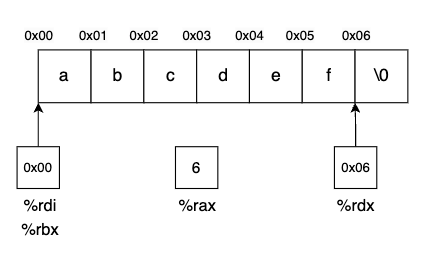
<+1> : As analyzed before, what we enter is stored in %rdi as a single line of string. And this is also stored in %rbx.
<+4> : As analyzed in phase_1, string_length is a function that works with the registers %rdi and %rdx and returns the gap between them by storing it in %rax.
<+9> : Compares that return value with 6.
<+12> : If the return value, i.e. the length of the string, isn't 6, it jumps to <+63> and the bomb explodes, so the string we enter must have length 6.
0x0000555555401509 <+63>: callq 0x555555401a90 <explode_bomb>
<+14 ~ 36>
   0x00005555554014d8 <+14>:	mov    %rbx,%rax
   0x00005555554014db <+17>:	lea    0x6(%rbx),%rdi
   0x00005555554014df <+21>:	mov    $0x0,%ecx
   0x00005555554014e4 <+26>:	lea    0x1675(%rip),%rsi        # 0x555555402b60 <array.3417>
   0x00005555554014eb <+33>:	movzbl (%rax),%edx
   0x00005555554014ee <+36>:	and    $0xf,%edx
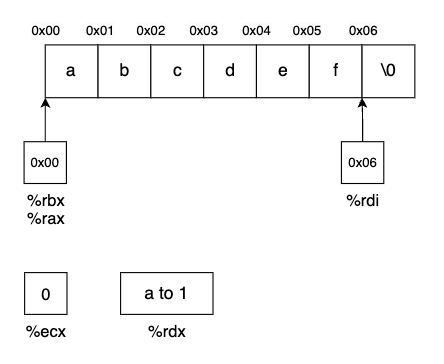
<+14> : Copies the pointer %rbx holds into %rax.
<+17> : Stores 0x6(%rbx), i.e. the 6th character, in %rdi.
<+21> : Stores 0 in %ecx.
<+26> : I'm guessing this stores an array.
<+33> : (%rax) is the first character of the string. This is stored in %edx.
<+36> : ANDs the first character with 15. Regardless of whether it's an uppercase or lowercase English letter or a digit character, it maps them in order to the integers 1 through 26.
| a | b | c | d | e | f | g | h | i | j | k | l |
|---|---|---|---|---|---|---|---|---|---|---|---|
| A | B | C | D | E | F | G | H | I | J | K | L |
| '1' | '2' | '3' | '4' | '5' | '6' | '7' | '8' | '9' | |||
| ↓ | ↓ | ↓ | ↓ | ↓ | ↓ | ↓ | ↓ | ↓ | ↓ | ↓ | ↓ |
| 1 | 2 | 3 | 4 | 5 | 6 | 7 | 8 | 9 | 10 | 11 | 12 |
| m | n | o | p | q | r | s | t | u | v | w | x | y | z |
|---|---|---|---|---|---|---|---|---|---|---|---|---|---|
| M | N | O | P | Q | R | S | T | U | V | W | X | Y | Z |
| ↓ | ↓ | ↓ | ↓ | ↓ | ↓ | ↓ | ↓ | ↓ | ↓ | ↓ | ↓ | ↓ | ↓ |
| 13 | 14 | 15 | 16 | 17 | 18 | 19 | 20 | 21 | 22 | 23 | 24 | 25 | 26 |
<+39 ~ 68>
   0x00005555554014f1 <+39>:	add    (%rsi,%rdx,4),%ecx
   0x00005555554014f4 <+42>:	add    $0x1,%rax
   0x00005555554014f8 <+46>:	cmp    %rdi,%rax
   0x00005555554014fb <+49>:	jne    0x5555554014eb <phase_5+33>
   0x00005555554014fd <+51>:	cmp    $0x3a,%ecx
   0x0000555555401500 <+54>:	je     0x555555401507 <phase_5+61>
   0x0000555555401502 <+56>:	callq  0x555555401a90 <explode_bomb>
   0x0000555555401507 <+61>:	pop    %rbx
   0x0000555555401508 <+62>:	retq
   0x0000555555401509 <+63>:	callq  0x555555401a90 <explode_bomb>
   0x000055555540150e <+68>:	jmp    0x5555554014d8 <phase_5+14>
<+39> : An array whose contents are hard to tell was stored in %rsi. And from the operand of this <+39>, we can see that the array in %rsi is accessed in 4-byte units. So we can view %rsi as holding a 4-byte int array.
(gdb) x/30dw $rsi
0x555555402b60 <array.3417>:	2	10	6	1
0x555555402b70 <array.3417+16>:	12	16	9	3
0x555555402b80 <array.3417+32>:	4	7	14	5
0x555555402b90 <array.3417+48>:	11	8	15	13
0x555555402ba0:	2032168787	1948284271	1802398056	1970239776
0x555555402bb0:	1851876128	1869902624	1752440944	1868701797
0x555555402bc0:	1998611053	543716457	1819440227	539779885
0x555555402bd0:	2032168804	4158831
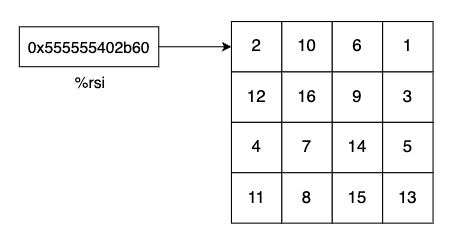
So, if we print the values stored in memory split into 4-byte units, we get the following.
I printed 30 of them, and up to the 16th there are values that look like they were put in deliberately, and after that there are garbage values, so I only wrote down the first 16 that seem like they'll be used.
And it stores in %ecx the element reached by moving through this array one slot at a time, as many times as the value of the first character we entered ANDed with 15.
Since I assumed we entered "abcdef", it stores 2, the first element.
<+42> : Adds 1 to %rax.
<+46> : Compares %rax and %rdi.
<+49> : If %rax and %rdi are different, jumps to <+33>.
<+51> : If %rax and %rdi are the same, compares 58 with %ecx.
<+54> : If it's 58, it jumps to <+61> and the phase is solved.
<Conclusion>
If we look at the situation,
%rax goes through the array from the first element to the last element.
While going through it, each character we entered acts as an index into the integer array above, and the integer the index points to is accumulated into %ecx.
And once it finishes going through the last element, R[%ecx] must be 58.
In other words, the string we need to enter is one where each character maps to 1 through 9 and their sum is 58, and there are tons of answers.
To give just a few examples,
first we need to split 58 into a sum of 6 numbers from the array above,
so we can split it as 10 + 10 + 10 + 16 + 9 + 3.
The index of each number is 1 1 1 5 6 7, and there are tons of possible combinations of characters that map to 1 1 1 5 6 7, including the ones below.
aaaefg, 111567, AAAEFG, a1156G