We'll analyze three functions.
phase_4
func4
__isoc99_sscanf
__isoc99_sscanf
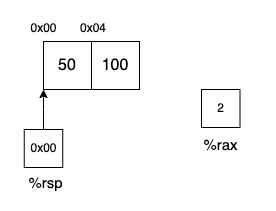
Summarizing what we found out about the __isoc99_sscanf function in phase2:
- The integers you enter are converted into an array from the string stored in %rdi.
- A pointer to the first element is stored in %rsp.
- The number of integers you entered is returned in %rax.
So if you entered 50 100, you get the situation on the right.
phase_4
Dump of assembler code for function phase_4:
=> 0x0000555555401455 <+0>:	sub    $0x18,%rsp
   0x0000555555401459 <+4>:	mov    %fs:0x28,%rax
   0x0000555555401462 <+13>:	mov    %rax,0x8(%rsp)
   0x0000555555401467 <+18>:	xor    %eax,%eax
   0x0000555555401469 <+20>:	lea    0x4(%rsp),%rcx
   0x000055555540146e <+25>:	mov    %rsp,%rdx
   0x0000555555401471 <+28>:	lea    0x1975(%rip),%rsi        # 0x555555402ded
   0x0000555555401478 <+35>:	callq  0x555555400fc0 <__isoc99_sscanf@plt>
   0x000055555540147d <+40>:	cmp    $0x2,%eax
   0x0000555555401480 <+43>:	jne    0x555555401488 <phase_4+51>
   0x0000555555401482 <+45>:	cmpl   $0xe,(%rsp)
   0x0000555555401486 <+49>:	jbe    0x55555540148d <phase_4+56>
   0x0000555555401488 <+51>:	callq  0x555555401a90 <explode_bomb>
   0x000055555540148d <+56>:	mov    $0xe,%edx
   0x0000555555401492 <+61>:	mov    $0x0,%esi
   0x0000555555401497 <+66>:	mov    (%rsp),%edi
   0x000055555540149a <+69>:	callq  0x555555401421 <func4>
   0x000055555540149f <+74>:	cmp    $0x7,%eax
   0x00005555554014a2 <+77>:	jne    0x5555554014ab <phase_4+86>
   0x00005555554014a4 <+79>:	cmpl   $0x7,0x4(%rsp)
   0x00005555554014a9 <+84>:	je     0x5555554014b0 <phase_4+91>
   0x00005555554014ab <+86>:	callq  0x555555401a90 <explode_bomb>
   0x00005555554014b0 <+91>:	mov    0x8(%rsp),%rax
   0x00005555554014b5 <+96>:	xor    %fs:0x28,%rax
   0x00005555554014be <+105>:	jne    0x5555554014c5 <phase_4+112>
   0x00005555554014c0 <+107>:	add    $0x18,%rsp
   0x00005555554014c4 <+111>:	retq
   0x00005555554014c5 <+112>:	callq  0x555555400f20 <__stack_chk_fail@plt>
<+28>
It puts "%d %d" in %rsi and passes it as an argument to the __isoc99_sscanf function.
(gdb) x/s 0x555555402ded
0x555555402ded:	"%d %d"
<+35>
-
Since the function is called with "%d %d", we can tell that we need to enter two integers.
-
A pointer to the integer array is stored in %rsp.
-
The number of integers entered is stored in %rax.
<+40 ~ 43>
   0x000055555540147d <+40>:	cmp    $0x2,%eax
   0x0000555555401480 <+43>:	jne    0x555555401488 <phase_4+51>
0x0000555555401488 <+51>: callq 0x555555401a90 <explode_bomb>
<+40> : Compares the number of integers entered with 2.
<+43> : If the number of integers entered is not 2, it jumps to <+51> and the bomb explodes, so the number of integers you have to enter is 2.
<+45 ~ 69>
   0x0000555555401482 <+45>:	cmpl   $0xe,(%rsp)
   0x0000555555401486 <+49>:	jbe    0x55555540148d <phase_4+56>
   0x0000555555401488 <+51>:	callq  0x555555401a90 <explode_bomb>
   0x000055555540148d <+56>:	mov    $0xe,%edx
   0x0000555555401492 <+61>:	mov    $0x0,%esi
   0x0000555555401497 <+66>:	mov    (%rsp),%edi
   0x000055555540149a <+69>:	callq  0x555555401421 <func4>
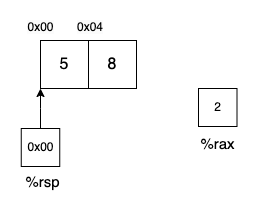
<+45> : (%rsp) is the first integer entered, as shown in the figure on the right. It compares the first integer with 14.
<+49> : Since this is an unsigned comparison, if the first integer is less than 0 or greater than 14, it moves to <+51>.
<+51> : The bomb explodes. In other words, the first integer must be at least 0 and at most 14.
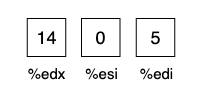
<+56> : Stores 14 in %edx.
<+61> : Stores 0 in %esi.
<+66> : Stores the first integer in %edi.
<+69> : Since func4 is called right away, we can guess that %edx, %esi, and %edi act as the function's arguments.
<+72 ~ 69>
   0x000055555540149f <+74>:	cmp    $0x7,%eax
   0x00005555554014a2 <+77>:	jne    0x5555554014ab <phase_4+86>
   0x00005555554014a4 <+79>:	cmpl   $0x7,0x4(%rsp)
   0x00005555554014a9 <+84>:	je     0x5555554014b0 <phase_4+91>
   0x00005555554014ab <+86>:	callq  0x555555401a90 <explode_bomb>
   0x00005555554014b0 <+91>:	mov    0x8(%rsp),%rax
   0x00005555554014b5 <+96>:	xor    %fs:0x28,%rax
   0x00005555554014be <+105>:	jne    0x5555554014c5 <phase_4+112>
   0x00005555554014c0 <+107>:	add    $0x18,%rsp
   0x00005555554014c4 <+111>:	retq
   0x00005555554014c5 <+112>:	callq  0x555555400f20 <__stack_chk_fail@plt>
<+74> : After func4 returns, R[%eax] will be either still 2 (it's guaranteed that the number of integers entered is always two) or func4's return value. It compares that value with 7.
<+77> : If R[%eax] is not 7, it moves to <+86> and the bomb explodes, so we can tell that func4 is a function that has a return value.
And we have to pass arguments so that func4's return value comes out as 7.
<+79> : 0x4(%rsp) is the second number entered. It compares the second number with 7.
<+84> : Checks whether the second number equals 7.
<+86> : If the second number is not 7, the bomb explodes, so the second number must be 7.
<After that> : This is ordinary code for finishing a function.
Before analyzing func4, let's sum up the conditions we need to solve the problem.
- The first number entered must be at least 0 and at most 14.
- The second number entered must be 7.
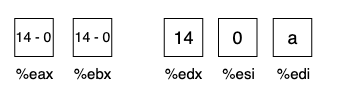
- %edx, %esi, and %edi are passed as arguments, and their values are as follows. R[%edx] = 14, R[%esi] = 0, R[%edi] = the first integer entered
- We have to pass arguments so the return value is 7, but R[%edx] and R[%esi] are fixed at 14 and 0. So we have to pass R[%edi] such that the return value is 7. In other words, we have to enter the first integer so that the return value comes out as 7.
func4
Dump of assembler code for function func4:
   0x0000555555401421 <+0>:	push   %rbx
   0x0000555555401422 <+1>:	mov    %edx,%eax
   0x0000555555401424 <+3>:	sub    %esi,%eax
   0x0000555555401426 <+5>:	mov    %eax,%ebx
   0x0000555555401428 <+7>:	shr    $0x1f,%ebx
   0x000055555540142b <+10>:	add    %eax,%ebx
   0x000055555540142d <+12>:	sar    %ebx
   0x000055555540142f <+14>:	add    %esi,%ebx
   0x0000555555401431 <+16>:	cmp    %edi,%ebx
   0x0000555555401433 <+18>:	jg     0x55555540143d <func4+28>
   0x0000555555401435 <+20>:	cmp    %edi,%ebx
   0x0000555555401437 <+22>:	jl     0x555555401449 <func4+40>
   0x0000555555401439 <+24>:	mov    %ebx,%eax
   0x000055555540143b <+26>:	pop    %rbx
   0x000055555540143c <+27>:	retq
   0x000055555540143d <+28>:	lea    -0x1(%rbx),%edx
   0x0000555555401440 <+31>:	callq  0x555555401421 <func4>
   0x0000555555401445 <+36>:	add    %eax,%ebx
   0x0000555555401447 <+38>:	jmp    0x555555401439 <func4+24>
   0x0000555555401449 <+40>:	lea    0x1(%rbx),%esi
   0x000055555540144c <+43>:	callq  0x555555401421 <func4>
   0x0000555555401451 <+48>:	add    %eax,%ebx
   0x0000555555401453 <+50>:	jmp    0x555555401439 <func4+24>
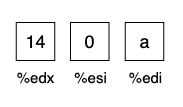
If we let the first integer entered be a (0 <= a <= 14),
the arguments passed are R[%edx] = 14, R[%esi] = 0, R[%edi] = a.
We have to make the return value 7 through the value of a.
<+1 ~ 5>
   0x0000555555401422 <+1>:	mov    %edx,%eax
   0x0000555555401424 <+3>:	sub    %esi,%eax
   0x0000555555401426 <+5>:	mov    %eax,%ebx
<+7 ~ 14>
   0x0000555555401428 <+7>:	shr    $0x1f,%ebx
   0x000055555540142b <+10>:	add    %eax,%ebx
   0x000055555540142d <+12>:	sar    %ebx
   0x000055555540142f <+14>:	add    %esi,%ebx
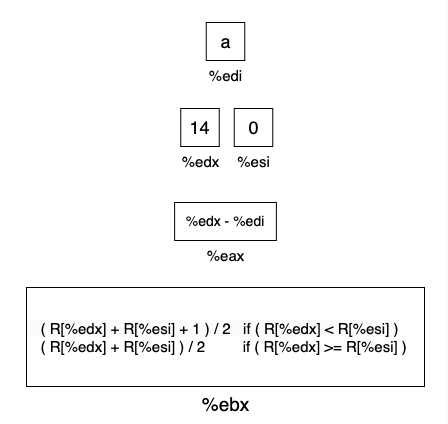
<+7> : Shifts %ebx right by 31. You can think of this as extracting the sign of %ebx.
<+10> : Adds %eax to %ebx.
<+12> : Shifts %ebx right once while preserving the sign. This is the same as dividing %ebx by 2.
<+14> : Adds %edi to %ebx.
Putting together the expression computed so far gives what's on the right.
<+16 ~ 27>
   0x0000555555401431 <+16>:	cmp    %edi,%ebx
   0x0000555555401433 <+18>:	jg     0x55555540143d <func4+28>
   0x0000555555401435 <+20>:	cmp    %edi,%ebx
   0x0000555555401437 <+22>:	jl     0x555555401449 <func4+40>
   0x0000555555401439 <+24>:	mov    %ebx,%eax
   0x000055555540143b <+26>:	pop    %rbx
   0x000055555540143c <+27>:	retq
<+16> : Compares R[%ebx] and R[%edi].
<+18> : If %ebx is greater, it jumps to <+28>.
<+20> : Compares again.
<+22> : If %ebx is smaller, it jumps to <+40>.
<+24> : It's neither greater nor smaller, so R[%ebx] == R[%edi]. Then it puts %ebx into %eax and returns.
<+28 ~ 50>
   0x000055555540143d <+28>:	lea    -0x1(%rbx),%edx
   0x0000555555401440 <+31>:	callq  0x555555401421 <func4>
   0x0000555555401445 <+36>:	add    %eax,%ebx
   0x0000555555401447 <+38>:	jmp    0x555555401439 <func4+24>
   0x0000555555401449 <+40>:	lea    0x1(%rbx),%esi
   0x000055555540144c <+43>:	callq  0x555555401421 <func4>
   0x0000555555401451 <+48>:	add    %eax,%ebx
   0x0000555555401453 <+50>:	jmp    0x555555401439 <func4+24>
R[%ebx] > R[%edi]
- <+28> : Does R[%edx] = R[%rbx] - 1.
- <+31> : Goes back to the start of the code and calls itself recursively.
R[%ebx] > R[%edi]
- <+40> : Does R[%esi] = R[%rbx] + 1.
- <+34> : Goes back to the start of the code and calls itself recursively.
func4 conclusion
If you look at the code closely, you can see that it's code performing a binary search.
The search range is 0 to 14, where %esi handles the minimum, and %edx.
The search target is %edi, the first number we entered.
Then it stores the middle index between %edx and %esi in %ebx, compares that value with the target %edi, and branches.In the end, the return value is %ebx at the moment the search succeeds.
The return value having to be 7 means the index at the moment the search succeeds has to be 7.
Also, the search succeeding means R[%ebx] == R[%edi], so the first number, which is the search target, has to be 7.
It's a mystery why it runs a binary search on an array where the index and the value are exactly the same,
but in the end the first number has to be 7 and the second number has to be 7, so the answer is:
7 7